

The dual micro-card has obtained the carbon footprint quantification certification. Foton Motor Corporation's comprehensive heavy and light vehicle matrix leads the low-carbon transformation in the logistics industry.
Under the backdrop of the deepening implementation of the "carbon neutrality" goal and the accelerated transformation of the energy structure, the green transformation in the transportation sector has become a crucial battlefield for achieving emission reduction targets. As the "big emitter" of carbon emissions in the transportation field, the effectiveness of the low-carbon transformation of commercial vehicles directly affects the pace of the overall strategy's implementation.
Recently, Foton Motor has once again achieved good news. The Carbon Publicity Platform of China's Automotive Industry Chain (CPP platform) officially announced the list of the latest batch of carbon footprint quantification labels. The Xiangling V5 pure electric mini truck and the Xiangling Q gasoline mini truck of Foton Motor both made the list. This achievement not only serves as an important verification of low-carbon technology in the micro-truck sub-segment for Foton Motor, but also indicates that it has fully covered the carbon footprint quantification labels for all types of commercial vehicles, including heavy trucks, light trucks, and micro trucks, achieving a comprehensive coverage. This injects strong confidence into the green development of the industry.
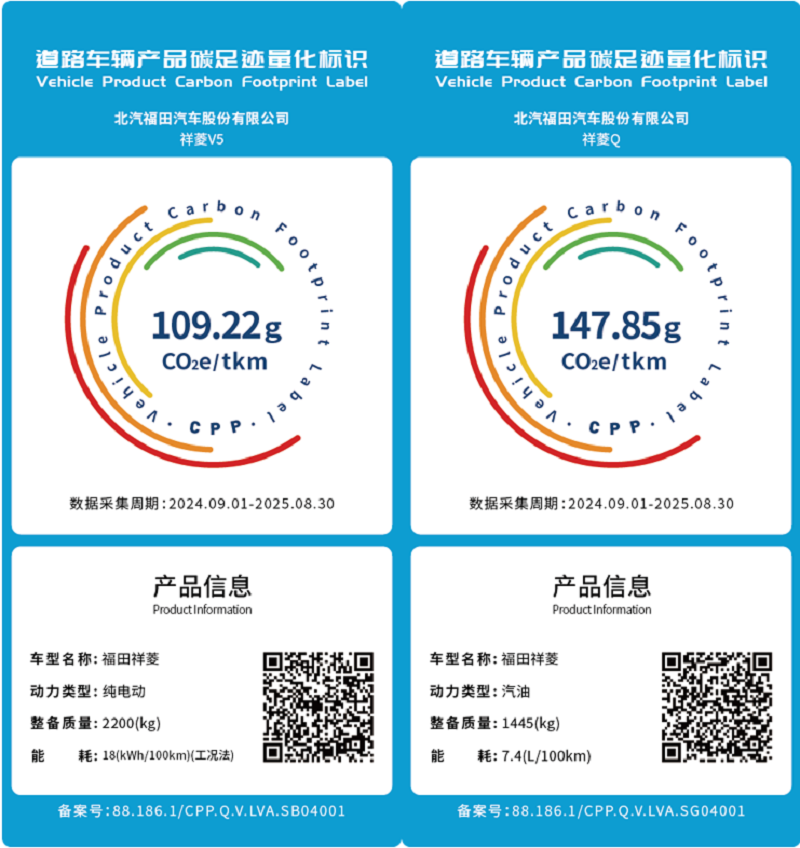
Dual micro-cards for placement, with complete coverage of minor carbon footprint labels
As the most authoritative public display platform in the field of carbon footprint quantification for commercial vehicles in China, the certification system of the CPP platform focuses on the carbon emissions throughout the vehicle's entire life cycle. It mainly focuses on the emission efficiency during the usage stage. Among them, the indicator "carbon emissions per ton-kilometer (gCO₂e/tkm)" is a key benchmark for precisely measuring the carbon emission intensity during the transportation process of commercial vehicles, directly reflecting the environmental performance and economic value of the vehicles in actual operation.
This time, the two micro-truck products of Foton Motor that made the list demonstrated the technical strength and emission reduction achievements of Foton Motor from different power lines. Among them, the Xiangling Q gasoline micro-truck, as the main model for urban distribution logistics scenarios, has a curb weight of 1445kg and a combined fuel consumption of 7.4 liters per 100 kilometers, with a corresponding carbon footprint of 147.85gCO₂e/tkm per unit product; while the other electric model Xiangling V5 showcased the emission reduction advantages of new energy technology, with a curb weight of 2200kg and an electric consumption of 18kWh per 100 kilometers under combined working conditions, with a unit carbon footprint as low as 109.22gCO₂e/tkm.
In fact, apart from the two micro truck models that have been publicly announced this time, as early as November 2024, four truck models including Foton Emonca S1 and Emonca Zhiblue ES1 had already passed the CPP platform review. Subsequently, in March 2025, the Oumaangyelang 5 and Oumaangxingyi 2 heavy truck models also successfully obtained the carbon footprint certification. Currently, with the full coverage of micro trucks, light trucks, and heavy trucks, Foton Automobile has established the most complete low-carbon commercial vehicle product portfolio in China.
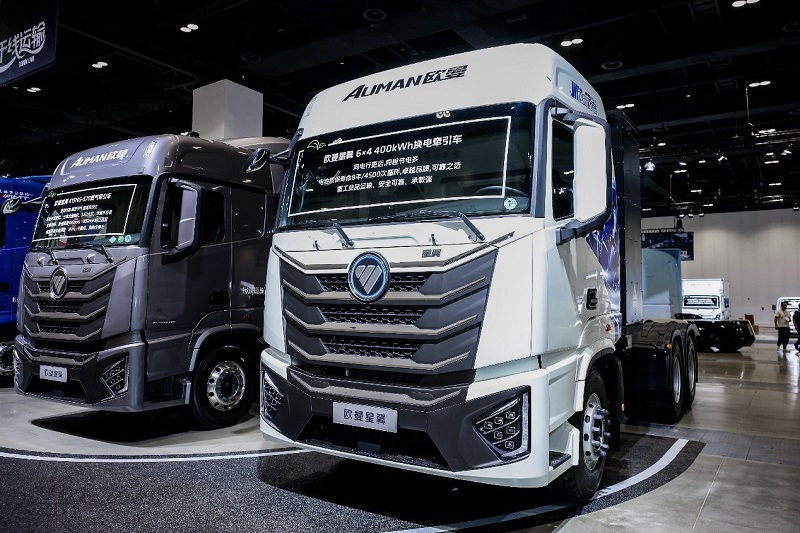
Deepening the new energy strategy to empower the low-carbon transformation of the logistics industry
Futong Automobile's comprehensive low-carbon breakthrough is not an accident; rather, it stems from its two-decade-long in-depth exploration and meticulous work in the field of new energy, as well as its clear and firm strategic planning.
It is known that as early as 2003, when new energy commercial vehicles were still in the conceptual stage, Foton Motors had already initiated relevant research and development work, becoming one of the earliest enterprises in China to lay out the development of new energy commercial vehicles. Through more than two decades of technological accumulation and iteration, Foton Motors has always regarded the new energy strategy as an important strategic for its development. In response to the national "dual carbon" goals, it has clearly planned to achieve the carbon peak of the enterprise in 2028, promote the carbon neutrality goal of its core production plants by 2035, and complete the carbon neutrality transformation of the entire value chain by 2050, thus drawing a clear green roadmap for its development.
Entering 2025, the electrification of commercial vehicles has shifted from being driven by policies to being driven by technology and economic factors. Thanks to the early implementation of a firm low-carbon strategy and profound technological accumulation, Foton Motor has already established a comprehensive technical layout covering pure electric, hydrogen fuel, and hybrid technologies. It has developed over 900 new energy products, covering various commercial vehicle application scenarios such as urban logistics, long-distance transportation, and engineering operations. In terms of sales, from January to October this year, Foton Motor has sold a total of 65,500 new energy trucks, a year-on-year increase of 130%. The proportion of new energy products in Foton Motor's total sales has also exceeded 15%, becoming the core growth engine of its overall business.
From the perspective of industry development, as the construction of the national carbon market continues to advance, green and low-carbon have become an irreversible development constraint for the logistics industry. Under this trend, the carbon footprint of vehicles will gradually become a key assessment indicator for bidding and market access. Low-carbon vehicle products and integrated solutions will transform into the core operational value of logistics enterprises.
From this, it can be seen that Foton Motors was the first to introduce a low-carbon vehicle model that has been officially certified. This precisely meets the needs of industry transformation. It not only helps logistics enterprises quickly adapt to the requirements of carbon market policies and avoid compliance risks such as excessive emissions fines and carbon quota purchases; but also, under the trend of gradually internalizing carbon costs, it can leverage the low-emission advantage to reduce the total life cycle operating costs. This leading position can help logistics enterprises seize the initiative in the green competition and achieve a low-carbon upgrade as soon as possible.


